What Is Print on Demand and How Does It Work for Beginners?
I still remember looking around my room at stacks of unsold custom T-shirts I had paid for upfront. I believed my online business would take off quickly, but weeks passed without a single sale. Watching my savings disappear while those boxes collected dust was both stressful and discouraging.
That experience taught me a valuable lesson: buying inventory before finding customers is one of the biggest risks for beginners. Many people dream of starting an ecommerce business, but the fear of losing money, dealing with unsold products, and managing shipping can quickly turn that dream into frustration.
If you have ever wondered whether there is a safer way to sell products online without investing in inventory first, print on demand may be the solution you have been looking for.
The "Aha" Moment: Discovering a Better Way to Sell
Well, I finally found a way out of that financial mess, and it completely changed how I look at business. I realized that the traditional way of selling physical products is broken for everyday people like us. We do not have thousands of dollars to risk on products that might never sell.
That is when I stumbled upon a completely different business model that felt almost too good to be true. It allowed me to sell custom products to people all over the world without ever buying a single item in advance. I did not have to pack boxes, print shipping labels, or worry about storing bulky inventory in my room anymore.
This magical system is exactly what we are going to explore today. By the time you finish reading this, you will have a crystal-clear understanding of how to build an online income stream safely. Let us break down this amazing concept so you can start your own journey without making the expensive mistakes I made.
So, What Exactly is Print on Demand?
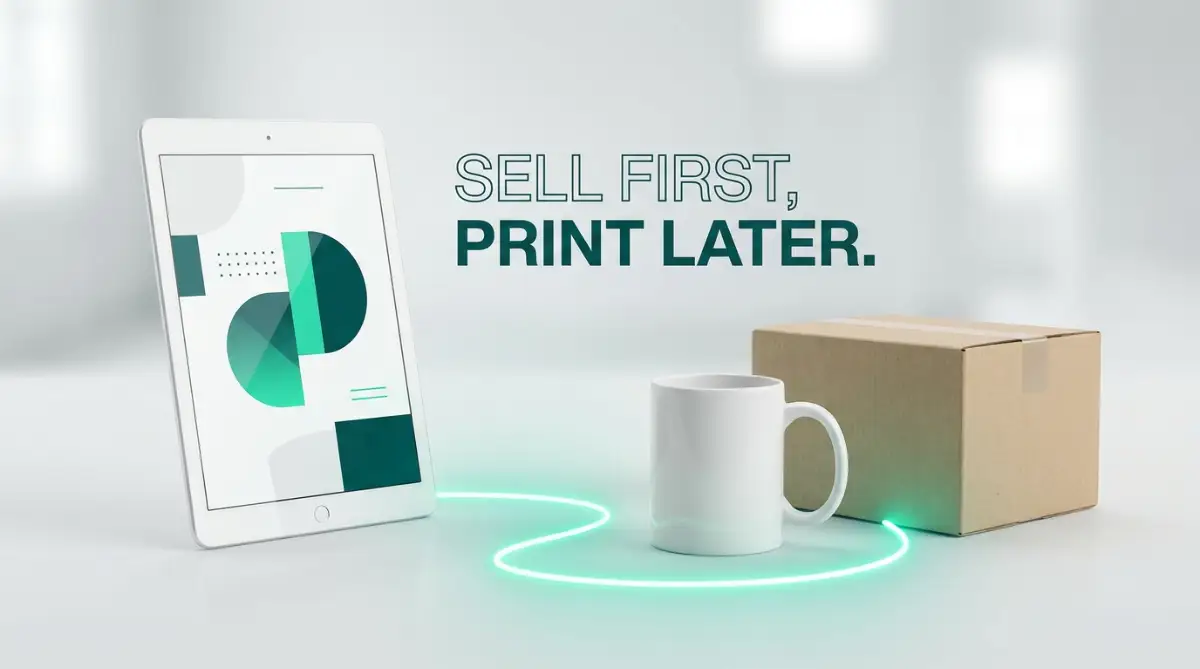
Print on demand, often called POD, is a smart online business model where you sell custom-designed products. The catch is that these products are only created and printed after a customer actually buys them. You never keep any physical stock, and you never pay for a product until you have already made a sale.
Think of it like a bakery that only bakes a cake after someone orders it. You create a digital design, place it on a blank product like a t-shirt or mug, and display it in your online store. When a visitor loves your design and buys it, your print partner automatically gets the order details.
They take a blank t-shirt, print your exact design on it, pack it up, and ship it directly to your customer. Your customer gets a beautiful product, the printing company gets paid for their work, and you keep the profit. It is a completely hands-off process for you, meaning you can run this business from a laptop anywhere in the world.
Traditional Ecommerce vs. Print on Demand
To really understand why this is so amazing for beginners, we need to compare it to normal ecommerce. When you run a traditional store, you have to guess what people want to buy. You order hundreds of items from a factory, pay for shipping to your house, and hope people actually buy them.
If a specific design or color does not sell, you are stuck with it forever, losing all that invested money. With print on demand, you can test a hundred different designs in your store for free. If a design gets zero sales, you lose absolutely nothing because that product never physically existed.
This completely removes the massive financial risk that usually stops beginners from starting an online business. It gives you the freedom to be creative, test wild ideas, and find out exactly what your audience loves. Your main job is creating designs and attracting customers, while the supplier handles production and shipping.
How the Entire Ecosystem Operates for Beginners
Now that you know the basic definition, you are probably wondering how all the moving parts actually connect. It might sound a bit complicated at first, but the technology available today makes it incredibly simple. Let us walk through the exact journey of a single product, from a simple idea to a happy customer.
Finding a Specific Audience (Your Niche)
Before you even think about designing anything, you need to know exactly who you are selling to. Trying to sell funny t-shirts to everyone on the internet is a guaranteed way to get zero sales. Instead, you need to find a specific group of passionate people, which we call a niche.
This could be people who absolutely love rescue dogs, introverted coffee addicts, or passionate indoor plant owners. When you focus on a specific group, your designs will speak directly to their emotions and hobbies. They are much more likely to pull out their credit cards when they feel a product was made just for them.
Creating Simple but Lovable Designs
Once you know your audience, it is time to create the artwork that will go on your products. A lot of beginners freeze here because they think they need to be professional graphic designers. The truth is, some of the best-selling products online are just clever text-based quotes with nice fonts.
You do not need to paint masterpieces; you just need to express a feeling or a funny joke your niche will understand. There are amazing beginner-friendly tools available today that let you combine text and graphics easily. You can also hire affordable freelance designers to bring your ideas to life if you prefer not to design at all.
Pro Tip for Your First Designs
One lesson I learned early on was not to overcomplicate my designs. When I started my own store, I spent days trying to make one design look perfect. I used to spend days trying to make one single design look perfectly complex with amazing colors.
Pro Tip: I quickly realized that simple, relatable text jokes actually sold way better than my highly complex artwork. Keep your first few designs very clean and focus entirely on the emotional message rather than fancy graphics.
Connecting Your Store to a Supplier
After you have a few nice designs ready, you need a place to display them to the world. You will set up an online storefront using simple ecommerce platforms that require no technical skills. Once your store is live, you connect it to a print on demand supplier using a free app.
Watch This Quick Video Explanation:
If you are a visual learner, understanding how these apps connect your store to a printing facility is super important. Take a moment to watch this short video below, as it perfectly demonstrates how an order flows automatically from your website to the printing factory.
This connection is the absolute magic of the whole business model. When someone visits your website and buys that plant-lover mug, the app instantly alerts your printing supplier. You do not have to manually send emails or copy customer addresses; the software handles all the boring data transfer.
The Printing and Fulfillment Magic
While you are sleeping or spending time with your family, your printing partner goes to work. They grab a high-quality blank mug from their massive warehouse and load it into an industrial printer. Your digital design is permanently printed onto the physical product with amazing precision and vibrant colors.
After printing, their quality control team checks the item to ensure it looks perfect. They carefully pack it into a secure shipping box so it does not break during transit. Finally, they stick a shipping label on the box that has your store's name on it, not theirs.
The Customer Experience
Your customer receives a tracking number automatically via email, so they can watch their package travel to them. When the box arrives at their doorstep, they open it and see a beautiful product from your brand. They have absolutely no idea that a third-party printing factory was ever involved in the process.
To the customer, you are a professional, fully-stocked brand that delivered a fantastic shopping experience. They might even take a picture wearing your custom shirt and tag your store on social media. Meanwhile, you successfully ran an entire retail transaction without ever touching a piece of cardboard.
Unmasking the Financial Side (How You Make Money)
Understanding the money flow is incredibly important so you can set realistic expectations. In this business, you get to control your own profit margins by setting the retail price of your items. Let us look at a very practical scenario to see how a single sale puts cash in your pocket.
Imagine your print supplier charges $10 to print and package a basic white T-shirt. (Note: Actual costs and profit margins vary depending on the supplier, product, shipping location, and business expenses.) to print and package a basic white t-shirt. You decide to put that specific t-shirt on your online store and sell it for $25. A customer visits your store, loves the design, and pays you $25 through your checkout system.
You now have $25 sitting in your business account from the customer's payment. Your print supplier will then automatically charge your saved credit card the $10 Imagine your print supplier charges $10 to print and package a basic white T-shirt. (Note: Actual costs and profit margins vary depending on the supplier, product, shipping location, and business expenses.) base cost to fulfill that exact order. After paying the supplier, you are left with $15 of pure gross profit from that single transaction.
Why Pricing Matters So Much
You might be tempted to price your items very low just to get quick sales as a beginner. This is a common mistake that can actually hurt your brand's reputation and leave you with no profits. If you sell that same shirt for $12, you are only making $2, which will not cover your website fees.
People are actually willing to pay a premium price for a product that deeply resonates with their personality. If a dog lover sees a hoodie that perfectly describes their unique pet, they will happily pay $40 or more. Value in this business is built on the emotional connection of your design, not just the raw materials of the shirt.
Always ensure you leave enough profit margin to cover any future advertising costs or software subscriptions. A healthy profit margin gives your business the oxygen it needs to survive and grow over time.
Busting Common Myths About This Business
Whenever a new way of making money becomes popular, a lot of confusing rumors start spreading around. I want to clear up some of these myths right now so you can approach your new store with a clear head. Having the right mindset is just as important as having good designs.
Myth 1: It is completely free to start.
While you do not need to buy bulk inventory, running a real business always requires some small investments. You will need to pay for your website hosting, maybe a domain name, and a few design tools. However, starting this way costs a tiny fraction of what a traditional physical store would require.
Myth 2: It is a magical get-rich-quick scheme.
Many beginners think they will upload three designs today and buy a luxury car by next month. The reality is that this is a real business that requires patience, learning, and consistent daily effort. You have to learn how to attract customers, write good product descriptions, and build trust with your audience.
Myth 3: The market is already too saturated.
People often worry that there are too many sellers out there already. But the truth is, there are always new trends, new hobbies, and new passionate communities forming every single day. If you bring a unique angle or a fresh sense of humor to a specific niche, you can easily stand out from the crowd.
Building an online income is entirely possible for anyone willing to put in the focused work. You just need to follow the right steps, test different ideas, and never stop learning about your target customers.
Taking Your New Online Store to the Next Level
Once your store is set up and your designs are live, the real fun begins. You cannot just wait around hoping people will magically find your website. You need to actively push your amazing products out into the world.
There are specific strategies that separate successful sellers from those who never make a dime. Let us explore some highly effective methods to bring eager buyers directly to your digital storefront. These are the exact steps professionals use to build long-term, profitable businesses.
The Secret Power of Ordering Physical Samples
One of the smartest things you can do is order a sample of your own product. You might think this is a waste of money, but it is actually a powerful marketing investment. When the item arrives at your house, you get to feel the fabric and test the print quality yourself.
More importantly, having the physical item allows you to take your own lifestyle photos. You can ask a friend to wear your custom t-shirt while you snap pictures on your smartphone at a local park. These natural, real-life photos build immense trust with your customers compared to digital mockups.
When buyers see a real person enjoying your product, their brain immediately registers your brand as trustworthy. According to a consumer behavior report published by the Harvard Business Review, visual social proof heavily influences purchasing decisions. Taking your own photos is the easiest way to create that powerful social proof.
Mastering the Art of Free Social Media Traffic
You do not need a massive advertising budget to get your first few sales. Social media platforms are essentially free billboards for your online business if you use them correctly. The trick is to create content that entertains your specific audience rather than just spamming links.
For example, if you sell products for cat owners, do not just post pictures of your mugs. Instead, post funny videos of cats doing silly things and feature your mug naturally in the video. People will watch for the funny cat, notice your cool mug, and visit your website to buy it.
Pinterest is another absolute goldmine for this specific business model. It is a visual search engine where people actively go to look for shopping inspiration and gift ideas. By pinning your product images with the right search terms, you can get free, continuous traffic for months.
Funding Your Initial Store Costs
While this business model is incredibly cheap to start, you still have some minor expenses like website hosting. If you are worried about covering these small monthly fees, you can easily use other online skills to fund your store. You do not need to dip into your personal savings if you play it smart.
For instance, you can use your free time to start freelance writing with no experience and get paid online. The money you make from writing a few articles can easily pay for your store's domain name and subscription. This removes all financial pressure, allowing you to build your store with total peace of mind.
Similarly, you could explore how to earn money through online proofreading to generate some quick side cash. Combining a simple service-based side hustle with your new ecommerce store is a brilliant way to protect your personal finances. You can find more finance tips and online income guides on our homepage to help manage your growing online empire.
Writing Product Descriptions That Actually Sell
Most beginners write terrible product descriptions that only talk about the fabric and size. Your customers already know what a t-shirt is; they do not need you to explain cotton to them. Instead, you need to write descriptions that trigger an emotional response and make them smile.
If you are selling a cozy hoodie for introverts, describe the exact feeling of wearing it. Tell them how perfect it is for a rainy Sunday afternoon reading a book by the window. Paint a vivid picture in their mind so they can imagine themselves already owning and loving the product.
Offering Standout Customer Support
Even though you never touch the products, you are still the face of your brand. If a package gets delayed in the mail, your customer is going to email you, not the printing facility. How you handle these minor bumps will completely define your store's reputation.
Always reply to customer emails quickly and with a super friendly tone. If an item arrives damaged, apologize immediately and send them a free replacement through your supplier app. Good customer service turns an angry buyer into a lifelong fan who will recommend you to their friends.
The Hidden Traps That Destroy New Store Owners
Building an online income is exciting, but the journey is filled with hidden traps. So many beginners rush into this business with huge excitement, only to crash and burn a few weeks later. Let us look at the most dangerous mistakes you must avoid at all costs.
The Copyright and Trademark Nightmare
This is easily the fastest way to get your store permanently banned and face legal trouble. Many beginners think it is perfectly fine to put logos from famous movies, sports teams, or cartoon characters on their shirts. They assume that because they are a small store, nobody will ever notice or care.
The truth is, large companies have automated software that constantly scans the internet for stolen intellectual property. According to guidelines from the United States Copyright Office, unauthorized use of protected designs can result in massive financial penalties. Always create your own original concepts or buy commercial licenses for the artwork you use.
Pricing Yourself Out of Business
We touched on this earlier, but it is such a massive trap that it needs a deeper look. Beginners often get terrified that nobody will buy their items, so they slash their prices to the absolute bottom. They end up making maybe one dollar of profit per sale, which is a complete disaster.
When you price your items too cheaply, customers actually assume the quality is terrible. Plus, you will not have any profit left over to pay for future advertising or website software. You must value your own creative work and price your products like a premium, trustworthy brand.
The "Set It and Forget It" Illusion
There is a huge myth online that passive income means doing absolutely zero work. Some people genuinely believe they can upload five designs on a Sunday and wake up rich on Monday. When they do not get any sales after three days, they get incredibly angry and quit entirely.
This is a real business, and real businesses require consistent care, feeding, and attention. You have to continuously test new design ideas, tweak your website, and post on social media. If you treat it like a temporary lottery ticket, you will get absolutely nowhere.
Choosing the Cheapest Possible Supplier
When you are setting up your backend systems, you will find dozens of different printing companies to choose from. It is very tempting to pick the one that offers the absolute lowest printing cost to maximize your profit. However, cheap suppliers usually have terrible print quality and incredibly slow shipping times.
If your customer waits a month for a shirt that fades after one wash, they will demand a refund. They will also leave angry reviews on your website, which will scare away any future buyers. Always choose a trusted, highly-rated supplier, even if it costs you an extra dollar or two per item. You can verify supplier reliability by checking fulfillment data from industry monitors like the National Retail Federation.
Your Next Steps Toward Financial Freedom
We have covered a massive amount of ground today, and you should be incredibly proud of yourself for learning all of this. You now understand exactly how products move from a simple digital idea to a physical item on a customer's doorstep. You know how the money flows, how to avoid dangerous legal mistakes, and how to properly market your brand.
The beauty of this system is that it completely removes the heavy financial barriers that keep most people stuck. You do not need a warehouse, you do not need packing tape, and you definitely do not need thousands of dollars in savings. You just need a laptop, an internet connection, and the willingness to learn a few simple new skills.
Every big brand you see online today started as a tiny idea in someone's head. They were just as scared and confused as you might be feeling right now, but they took that first brave step anyway. You have the exact same potential to build something amazing that can eventually support you and your family.
I know how scary it feels to start something completely new, especially when you have failed in the past. My first few stores were a total disaster, but I kept learning, kept testing, and eventually found a system that completely changed the way I approached online business.
Start small today, protect your peace of mind, and never stop believing in your ability to build a profitable future for yourself.
Five Essential Tips to Understand Print on Demand
1. Learn How Print on Demand Works
Print on demand (POD) lets you sell custom products like T-shirts, mugs, phone cases, and posters without buying inventory upfront. A product is printed and shipped only after a customer places an order, making it a low-risk business model for beginners.
2. Choose a Profitable Niche
Instead of selling products to everyone, focus on a specific audience. Niches such as pet lovers, fitness enthusiasts, gamers, teachers, or coffee fans often perform better because their designs feel more personal and targeted.
3. Create Simple, Original Designs
You do not need to be a professional designer to get started. Clean typography, unique illustrations, and trending ideas often outperform overly complicated artwork. Always use original designs or properly licensed graphics to avoid copyright issues.
4. Partner with a Reliable POD Platform
Choose a trusted print-on-demand provider that offers consistent print quality, fast shipping, and smooth integration with online marketplaces. Reliable fulfillment helps build customer trust and reduces refund requests.
5. Promote Your Store Consistently
Publishing products is only the beginning. Share your designs on social media, optimize product titles and descriptions for SEO, and test different marketing strategies. Consistent promotion gives your store the best chance to attract customers and generate sales over time.
Answers to Your Biggest Questions About Selling Custom Products
How much money do I actually need to start?
You can start with very little money compared to a normal business. Your main costs will be paying for a simple website platform, a custom domain name, and maybe some cheap design software. You never have to pay for the actual products until a customer buys them first.
Do I have to handle any shipping or returns?
No, your printing partner handles all the packaging and shipping directly to your customer. If a product arrives damaged or printed incorrectly, the supplier usually covers the cost of sending a free replacement. You just act as the friendly middleman handling the emails.
Can I sell products to people in other countries?
Yes, absolutely! Most major printing companies have facilities all over the world, from North America to Europe and Australia. When an order comes in, the software automatically routes it to the factory closest to your buyer for faster shipping.
What happens if nobody buys my designs?
If a design does not sell, you simply delete it and try a new one. Because you never bought any physical stock, you lose absolutely zero money on unsold items. This makes testing wild and crazy ideas completely risk-free.
Do I need to be a professional graphic designer?
Not at all. Some of the most profitable stores simply sell funny text quotes using basic fonts. You can also use beginner-friendly design apps or hire affordable freelancers to create artwork for you.
How do I actually get paid by the customer?
When you set up your online store, you will connect a secure payment gateway like Stripe or PayPal. The customer pays through your website, and the money goes directly into your connected bank account. You control the entire financial transaction.
Is this business model still profitable today?
Yes, people love buying personalized, unique items that they cannot find in a normal local mall. As long as you focus on a specific, passionate audience and create good designs, there is always room to make a profit. It just takes patience and consistent daily effort.
Can I start print on demand without any design experience?
Yes. Many beginners use beginner-friendly design tools or hire freelance designers. Simple, original text-based designs can also perform well when they connect with a specific audience.
Disclaimer: The information provided in this article is for educational and informational purposes only and does not constitute financial or legal advice. Starting any business involves risks, and individual results will vary based on effort, market conditions, and strategy. Always conduct your own thorough research and consider consulting with a professional before making any financial investments.