
Reading Time: 14 Minutes
Difficulty Level: Beginner to Intermediate
Reviewed By: FinanceInfoIn Editorial Team
The Unspoken Nightmare of the Six-Month Startup Trap
It is a strange and painful feeling to hold a signed contract for ten thousand dollars while having exactly four dollars in your bank account. You see a big, beautiful profit number on your computer screen, but when you stand at the gas pump, your card gets declined. This is the brutal trap that kills most independent businesses before they even get started.
You spend months building a product and finally get someone to buy it, only to realize that "getting paid" and "having money" are two completely different things. While you wait sixty days for a client to mail a check, your software bills and rent are leaving your account today. This daily financial anxiety is a silent killer, and if you don't fix the plumbing, even the best business idea will eventually choke.
This is the cold, hard truth of bootstrapping. You build a product with your own sweat and tears. You finally get people to buy it. You think the struggle is over, but then the real monster appears. It is called the "Cash Flow Gap."
It feels like you are running a race while someone is slowly tightening a rope around your neck. You have the revenue, but you don't have the money. You stop sleeping. You start avoiding calls from your landlord. You wonder if you should just quit and find a normal job with a steady paycheck.
This emotional rollercoaster is enough to break even the strongest person. You feel lonely because you cannot tell your team that you might not be able to pay them on Friday. You cannot tell your family because you don't want them to worry. If you are feeling this weight right now, please know that you are not alone. Most famous startups almost died exactly this way.

Quick Summary
Bootstrapped startups usually fail because they run out of physical cash, even if they are making sales. This happens because of delayed client payments and hidden daily expenses. To survive, you must demand upfront deposits, cut unused software subscriptions, and keep a strict cash reserve that is separate from your daily spending.
Key Takeaways
- Cash is Reality: Profit is just a theory on a piece of paper until the money hits your bank.
- Deposits are Mandatory: Never start working without a significant upfront payment.
- Audit Weekly: Small, forgotten bills can sink a large company over time.
- Buffer is Life: Aim for at least three months of survival cash in a separate account.
The Great Profit Illusion
The most dangerous mistake I ever made was thinking that a "profitable" month meant my business was safe. It took me a long time to realize that profit and cash are not the same thing.
Imagine you sell a service for $5,000. It costs you $3,000 to deliver it. You just made a $2,000 profit. But if the client doesn't pay you for 60 days, and you have to pay your team $3,000 today, you are actually "broke" for two months.
To help you see this clearly, look at how these two things actually work in the real world.
|
Metric |
What It Represents |
Why It Can Be Deceptive |
|
Net Profit |
Total revenue left after deducting all operational costs and taxes on paper. |
It records earned income immediately, but ignores whether the client has actually paid the bill. |
|
Cash Flow |
The physical money entering and leaving your bank account in real time. |
You can show record profits on your dashboard while having zero cash to pay rent or staff today. |
Think of profit as the destination on a map. It shows you where you are going. But cash flow is the gasoline in your car. If you run out of gas, it doesn't matter how beautiful the destination is—you aren't getting there.
The Real-Life Math of a Collapse
Let's look at a quick example with a founder named Sarah. Sarah runs a small design agency. She lands a dream project for $15,000. She hires a freelancer for $7,000 to help her finish the work in 30 days.
Sarah's business shows a profit of $8,000. However, the freelancer wants to be paid as soon as the work is done. The big corporate client Sarah is working for has a policy where they only pay invoices 60 days after the project is finished.
Sarah pays the freelancer $7,000 out of her own savings. Now, she has to wait another 60 days to get her $15,000 back. For two entire months, Sarah cannot pay her own rent. She is technically a "successful" business owner who is currently facing eviction. This is how bootstrapped startups collapse while they are growing.
Plugging the Invisible Money Leaks
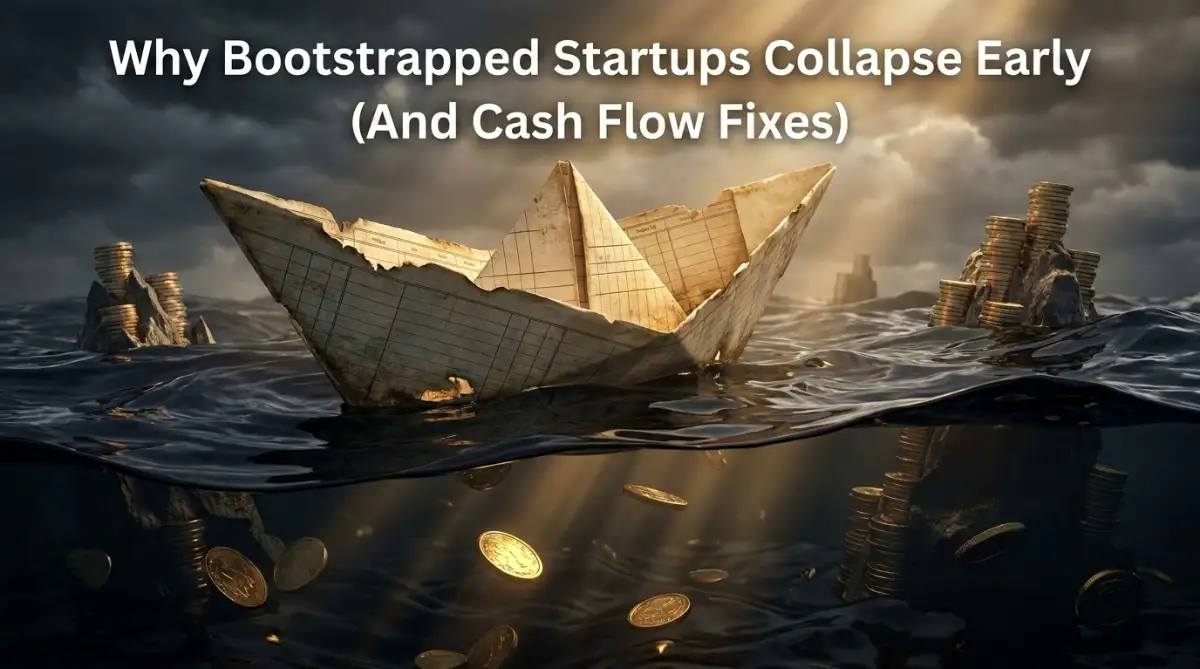
When your cash is low, you have to find every single leak in your boat. We often focus on big expenses, but the small ones are what usually sink us.
I once did an audit of my business bank statement and found $400 worth of monthly subscriptions for tools I hadn't opened in six months. That is $4,800 a year just disappearing into thin air.
|
The Money Leak |
Why It Stays Hidden |
The Quick Fix |
|
Ghost Subscriptions |
Small recurring charges between $15 and $30 go unnoticed on bank statements. |
Audit your accounts, cancel unused tools, and only resubscribe when absolutely needed. |
|
Annual Pre-Payments |
Paying upfront seems cheaper with a 10% discount, but it drains current cash. |
Switch to monthly billing to keep liquid cash inside the business today. |
|
Over-Allocated Software Tiers |
You pay for higher plans or 10 user seats, but only 2 people actually use them. |
Audit team access and downgrade immediately to the basic tier. |

How to Get Your Money Faster
You are not a bank. You should not be giving interest-free loans to your clients. If you are waiting 30 or 60 days to get paid, you are hurting your business.
The easiest fix is to change your payment terms. I started requiring a 50% deposit before I even opened my laptop to start a project. If a client says no, they are usually a client who was going to pay late anyway.
Watch this short guide on how to negotiate better payment terms without losing your clients:
Another trick is to offer a small discount for early payment. If you tell a client they can save 3% if they pay in 48 hours, you will be surprised how fast the money arrives. It is better to have 97% of your money today than 100% of it in two months.
Emergency Options When the Bank is Empty
Sometimes, even with a great plan, you hit a wall. A client disappears or a major expense hits you out of nowhere. You need to know your options before you panic.
Many people get confused between different ways to get quick money. Here is a simple breakdown of the two most common methods.
|
Funding Method |
How It Works |
The Main Risk |
|
Invoice Factoring |
You sell outstanding client invoices to a factoring company for immediate cash (usually 80% to 90% upfront). |
Factoring companies charge steep fees (1% to 5% per month), which significantly cuts into your project profit margins. |
|
Business Line of Credit |
A bank approves a revolving credit limit that you can draw from and repay as needed. |
High variable interest rates can quickly turn a short-term cash patch into heavy, compounding debt if client payments stall. |
My Pro Tip: Before you go to a bank, look at your current clients. I once saved my business by calling three clients and offering them a "special one-time deal" if they paid for their next six months of service in advance. I got $12,000 in two days without taking a loan.
Building Your Survival Buffer
The only way to stop the 2:00 AM panic attacks is to build a wall of cash. You need a separate savings account that you never look at.
Every time a client pays you, take 10% of that money and move it to the "Safety Account." Don't use it for marketing. Don't use it for a new desk. Only use it if your main account hits zero. Your goal is to have enough money in that account to keep your business running for three full months with zero sales.
The Pros and Cons of Staying Bootstrapped
The Pros:
- You own 100% of your company and make all the decisions.
- You don't have to answer to investors who only care about fast growth.
- It forces you to be creative and efficient with every dollar.
The Cons:
- Your personal money is always at risk.
- Growth is usually much slower than venture-backed companies.
- The stress of managing cash flow can cause physical and mental burnout.
Protecting Your Dream
Bootstrap startups don't fail because the idea is bad. They fail because the founder gets tired of fighting the cash flow monster every single day.
You must treat your bank account like a garden. You have to pull the weeds (unnecessary expenses) and make sure it has enough water (cash) to survive the dry seasons. Stop looking at your "profit" and start looking at your "available cash."
If you can master these simple fixes, you won't just survive. You will build a company that is strong enough to last for years. Keep your expenses low, get paid upfront, and always keep a little extra cash hidden away for a rainy day. Your future self will thank you for the peace of mind.
Mastering the Art of Financial Forecasting
Managing a business without outside funding feels like being a pilot flying through a thick fog. You know where you want to go, but you cannot see what is directly in front of you. Most founders only look at their bank balance once a week. This is a reactive way to live. To truly survive, you must become a financial "weather forecaster."
You need to look at your bank account and project exactly where it will be 30, 60, and 90 days from now. This isn't about complex accounting software. It is about knowing which checks are coming in and which bills are leaving. When you can see a "cash drought" coming two months in advance, you have time to fix it. You can launch a flash sale or delay a big purchase. If you wait until the bank hits zero, it is often too late to recover.
Another secret of high-level founders is the "Inventory of Skills." Instead of hiring a new employee for every task, they look at how they can automate small repetitive jobs using simple tools. Every dollar you save on a salary is a dollar that stays in your safety net. Before you hire someone, ask yourself: "Can a $20-a-month software do 80% of this work?" If the answer is yes, keep that cash in your business.
Building a sustainable business also means knowing when to say "no." Not every customer is a good customer. In fact, "bad" clients—those who complain constantly and pay late—actually cost you more money than they bring in. They drain your energy and prevent you from finding clients who value your time and pay on time. Part of your advanced strategy should be "firing" your most difficult 5% of clients every six months.
In my experience, you must treat your business as a separate living entity. It has its own needs and its own survival instincts. By mastering these forecasting skills, you are giving your business the intelligence it needs to navigate the toughest storms.
Pro Tip: Set an alarm for Friday morning at 10:00 AM every week. Spend exactly thirty minutes looking only at your "Expected Cash" vs "Expected Bills" for the next month. This habit alone can save your business.
How Different Forecasting Methods Save Your Cash
|
Forecasting Method |
Focus Area |
Real-World Strategic Benefit |
|
Historical Spend Audit |
Auditing past 90-day bank records and actual outflow patterns. |
Uncovers recurring zombie subscriptions and establishes your true baseline operating cost. |
|
Sales Pipeline Projection |
Weighting expected incoming deals by their probability to close. |
Warns you 60 days in advance if you need to ramp up outreach before revenue dips. |
|
Stress-Test (Zero-Inflow) |
Modeling runway assuming zero client payments for 30–60 days. |
Calculates your true operational survival window and forces proactive expense cuts. |

The Quiet Traps That Drain Your Energy and Bank Account
One of the most painful moments for any founder is realizing they have spent six months building something that no one wants to buy. This is a massive drain on your cash. People often make the mistake of "building in secret." They spend thousands on design and coding before they ever talk to a real human being.
Common Mistakes Founders Make Daily:
- Lifestyle Inflation: As soon as the business makes its first $5,000 profit, the founder buys a better car or a more expensive laptop. They treat the business account like a personal ATM.
- The "One More Feature" Trap: Thinking that adding one more button or one more service will suddenly